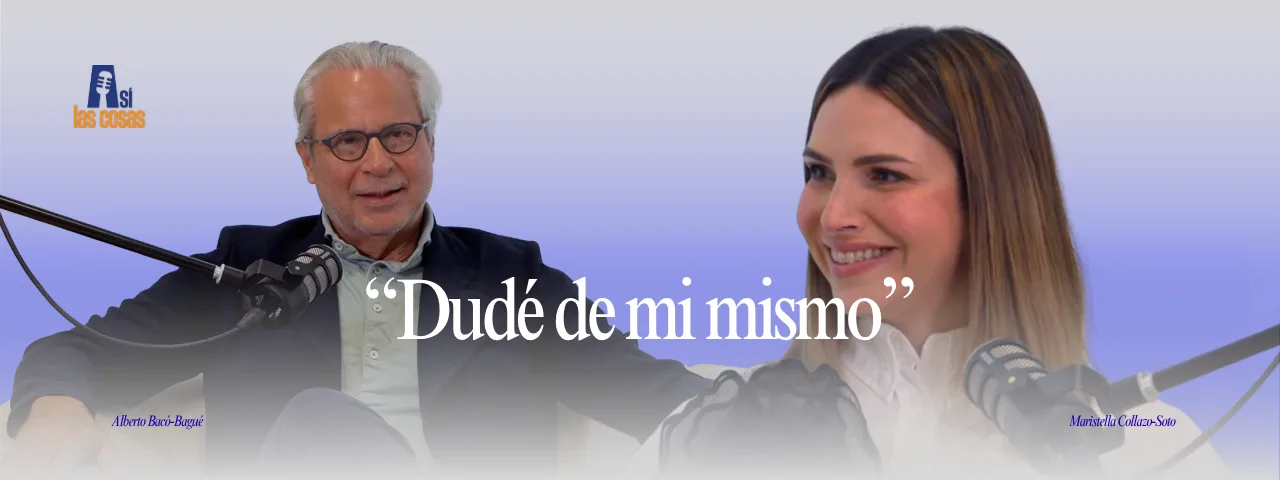
Alberto Bacó Bagué is an attorney, CPA, and entrepreneur who served as Puerto Rico’s Secretary of Economic Development and Commerce. In this conversation he does something people at his level rarely do on the record: he talks about imposter syndrome.
- He became second in command at Puerto Rico’s Government Development Bank without a finance degree, and had never worked at a bank. The role opened Wall Street’s doors to him at 28.
- His scar was educational. He hadn’t studied in the United States, and at tables where everyone traded Ivy League credentials he’d think: what am I doing here?
- He reframes it as “powerful vulnerability,” and credits his success to walking in with zero arrogance and saying out loud that he didn’t know.
- The Three Circles Method is his operating system: three pursuits at once, with purpose aligned to talent.
- His failed ventures share one cause. Not timing, not capital. Misaligned purpose.
- What he treasures from decades at the top isn’t Wall Street. It’s his coworkers.
Who is Alberto Bacó Bagué?
He’s an attorney, CPA, and entrepreneur known for company turnarounds and senior leadership across the public and private sectors. He served as Secretary of Economic Development and Commerce, and earlier as executive vice president of the Government Development Bank. In 2023 he was named to Bloomberg Línea’s 500 most influential people in Latin America and the Caribbean, one of three Puerto Ricans on it alongside Bad Bunny and Orlando Bravo. He found out by email at eight at night and assumed it was spam.
Ask him to describe himself and he leads with none of that.
“I’d start by drawing a boy playing in a furniture factory my grandfather founded.”
He worked in that factory at 11 and 12 years old. People could tell which pieces were his, because he used too many nails. His grandfather had designed a crib that converted into a bed once the baby outgrew the rails, built for families who couldn’t buy both. Maristella Collazo-Soto stopped him to say her two children had slept in one.
That factory taught him two things he still carries: his family’s rule that everyone was equal, from the shop floor up, and what it feels like when a business closes.

Do successful people get impostor syndrome?
Of course! and Bacó says so without hedging. He reached the second-highest post at the Government Development Bank, one of the larger banking institutions operating out of Puerto Rico at the time, without a finance degree and without ever having worked in a bank. At the top tables, he carried a specific scar: he had not studied at a United States university while everyone around him traded Ivy League credentials, and he kept asking himself what he was doing there.
His reframe is the line worth keeping. Bacó now calls that feeling powerful vulnerability. He traces his success to arriving without arrogance and saying plainly, I do not know this, I need the help of the people who do. That honesty, not a projected invincibility, is what let him pull a team together and do the job.
Fear was part of it too. Bacó says he lived with the terror of going broke even as his income rose every year. He doesn’t treat that as weakness. “Fear moves you in a good direction if you know how to face it.”
Maristella Collazo-Soto names what makes the admission rare. In her legal world, men do not talk about impostor syndrome, and hearing a leader of Bacó’s stature claim it openly is not something she had encountered.
FAQ: What does Alberto Bacó mean by “powerful vulnerability”?
It’s his reframe of imposter syndrome and the scars of a demanding career. Rather than hiding the doubt, he treats naming it as a source of strength, and credits it for how he worked with people who knew more than he did. He argues men in senior roles are trained to project strength instead of admitting it.
How do you actually find your purpose?
Not overnight, and not by feeling alone. Bacó describes his whole life as a long effort to understand each thing he did, from public accounting to banking to law, until the pieces fell into place when the governor offered him the economic development post. His sharpest lesson is about alignment: purpose has to be matched to your talents and to the moment in time you are in. Looking back at his bad business decisions, he says they share one cause, purpose that was not aligned.
This is where his Three Circles Method comes in. Three pursuits at once, always, with purpose aligned to talent.
“I’ve always done everything through my three circles method. I put it in three circles. I have to be doing three things at once.”
He’s lived it literally. He practiced law while running a food manufacturing and distribution company as president, while actively seeking board seats. Not sequentially. At the same time. He teaches it now as a way to align purpose, sustainability, and personal expression, and he’s blunt that he arrived at it the hard way.
FAQ: What is Alberto Bacó’s Three Circles Method?
It’s the framework he uses to align purpose with talent and with the moment a person is in. In practice it means running three pursuits at once, which he did by combining law, operating a company, and board service.

Why do good ventures still fail?
Misaligned purpose, not bad luck. He went back and analyzed his failures, and they had one thing in common. “Those bad experiences happened because my purpose wasn’t aligned.”
The nuance is what makes it useful. Purpose alone isn’t the answer. “Purpose has to be aligned with your talents and with the moment you’re in.”
He borrowed a metaphor from Don Ignacio Cortés, a mentor he honors by name. “Take life like a fruit tree. If the fruit is ripe, you can touch it and you won’t damage it. If you force fruit that isn’t ready, you’ll hurt the fruit and you won’t get your result.”
His own version, stated plainly: “If you’re five feet tall, don’t try to be the best basketball player in the NBA. You have to be authentic and honest with yourself.”
FAQ: What does Bacó say about chasing money?
That it doesn’t work. “You don’t make money by chasing it.” Find the needs you fill, understand your talents, do the work as well as you can, and let the money follow. Stop forcing outcomes.
What does he treasure most from decades at the top?
Not Wall Street. Not the bank. His coworkers.
Maristella asked him to name the single thing he carries from all those public service roles, and he warned her the answer would surprise her. It did.
“It was my coworkers.”
He traced it straight back to the drawing he’d opened with, the boy whose family taught him everyone was equal. Then the line that explains why: “What I remember is how people made me feel.”
There’s a second satisfaction driving his current work as a mentor. He holds a mirror up to someone and tells them he sees more talent than the goals they’re setting for themselves. When that person comes back later and says they raised their goals and are hitting them, he counts it as the win.
He also admits, unprompted, that he has bad days. He calls himself the biggest optimist there is, and still: people he has helped extensively, people with real money, tell him they have nothing to give his foundation. “You wake up discouraged. It happens to all of us.”
Where should a young professional start?
With mentors and peers, and he includes a confession about his own mistake.
“The best advice and the best paths in life come from mentors and from your peers.”
His filter is unsentimental: seek out people who have actually done it successfully, and don’t listen to the person who hasn’t, or to the one criticizing it, or to the one convinced it can’t be done.
That is the work he has given himself now. Through El Blueprint and his foundation, Bacó wants to hold up a mirror, especially for young people facing a harder search for purpose, so they see talent they are underusing and raise their goals. His measure of a good day is simple: someone tells him they set higher goals after he reflected their talent back to them, and then reached those goals.
The confession is the useful part. He was resistant to having mentors. Life handed him a few anyway, including Teodoro Moscoso and Jorge Luis Aquino, but in the moments he most needed one he should have gone looking and didn’t.
He closed with a warning for anyone measuring success on a short clock. “You have to postpone the gratification. That’s where a lot of people go wrong, thinking they’ll go serve and serve themselves at the same time. Results arrive calmly.”

FAQ: How do you find a mentor, according to Bacó?
Go looking rather than waiting. He was resistant to mentorship and only got mentors because life put them in his path. His recommendation is to prioritize conversations with peers and with people who have already done successfully what you’re trying to do.
Watch the full episode
The full conversation ranges wider than this piece. Bacó and Collazo-Soto also discuss his read on Puerto Rico’s economy and the Act 60, 20, and 22 incentives, which he views as working in some respects and under-adopted and poorly communicated in others, a debated topic he addresses as his own opinion. They get into why he built the El Blueprint podcast, the mentors who shaped him, and what he wants the next generation of Puerto Rican talent to come home to.
Where in your own work is your purpose out of alignment with your talents?
About Así las Cosas by Ferraiuoli
Así las Cosas is a podcast series by Ferraiuoli LLC, hosted by Capital Partner Maristella Collazo-Soto.
Guest in this episode: Alberto Bacó Bagué, attorney, CPA, and entrepreneur. He served as Secretary of Economic Development and Commerce of Puerto Rico from 2013 to 2017 and as chairman and president of the Government Development Bank. He is co-founder and managing director of RE Capital LLC, founder and director of the Partnership for Modern Puerto Rico, and host of the El Blueprint podcast. In 2023 he was named to Bloomberg Línea’s 500 Most Influential People in Latin America.