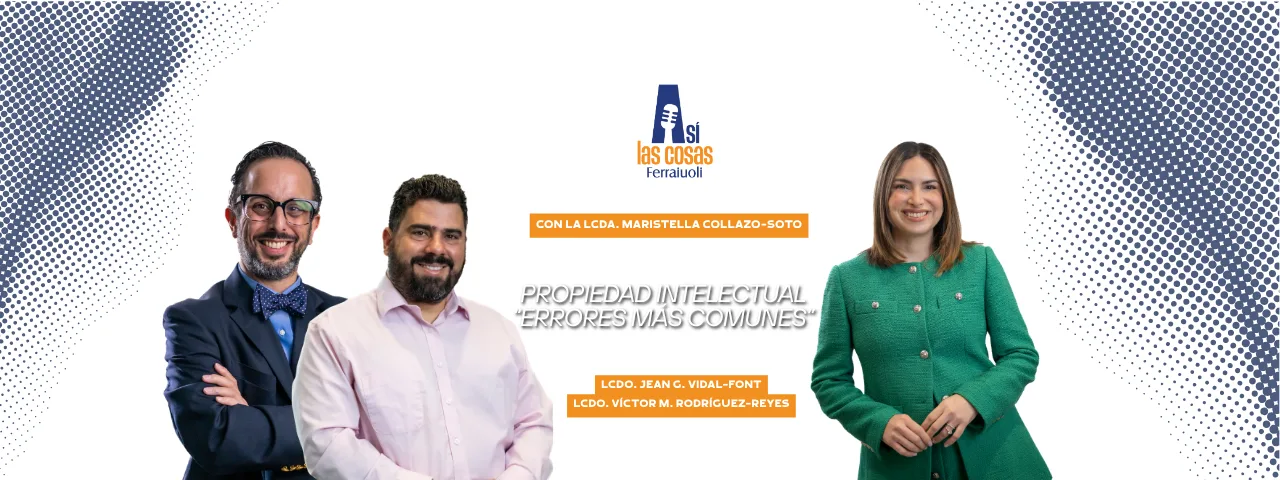
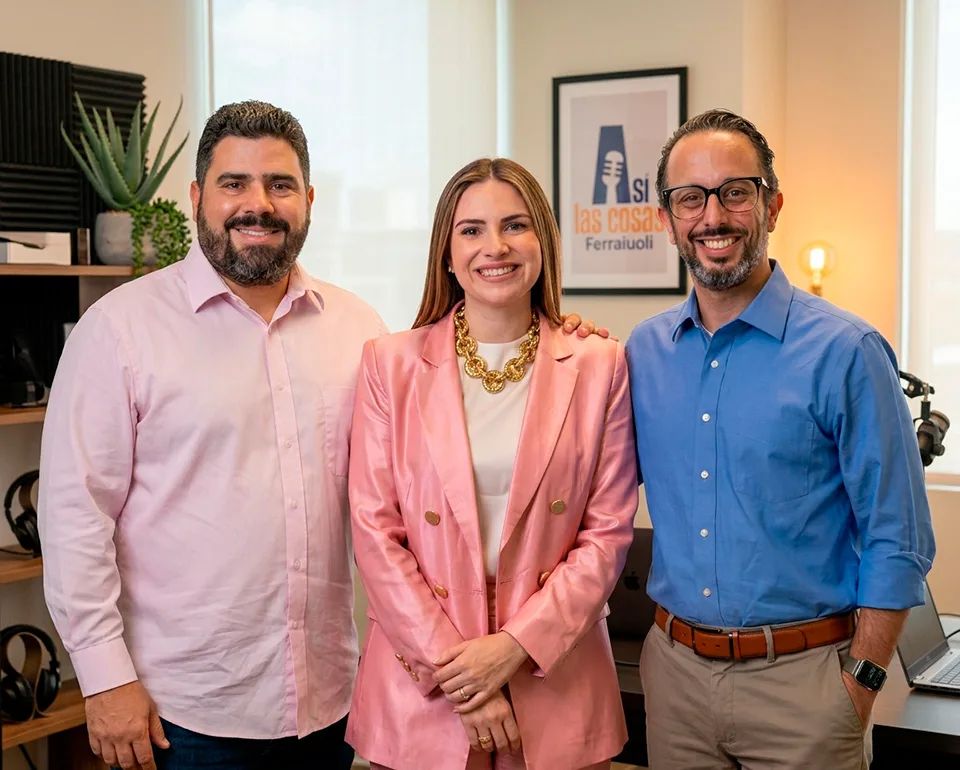
Ferraiuoli’s first fully substantive episode of Así las Cosas covers the intellectual property misconceptions three attorneys hear every week in their offices. Maristella Collazo-Soto hosts Víctor M. Rodríguez Reyes, a registered patent attorney and chemist, and Jean G. Vidal-Font, Capital Member and litigator working in AI and cybersecurity. What they said:
Registering your LLC does not protect your brand. Corporate registration at the Department of State and trademark registration are separate systems. One does not cover the other.
Ideas are cheap, execution is hard. A patent protects a product that succeeds. It does not create the success.
Publishing your invention starts a clock. The United States allows a one-year grace period to file after public disclosure. Most other countries do not, so the same disclosure can end your patent rights abroad immediately.
A registry search is not an availability search. One client cleared the registry and launched anyway. The conflicting mark had been in the market 23 years without registration.
AI is being treated as a solution instead of a tool, which is producing work with authorship problems and, in some cases, no protection at all.
The closing advice: you already own intellectual property. The question is what it is, where it sits, and whether your next move protects it or loses it.
Is something free to use because you found it on Google?
No. Appearing in a search result says nothing about who owns a work or what you are allowed to do with it. Jean G. Vidal-Font hears this one constantly from authors and creators, along with a related myth: that a small enough piece is automatically safe.
That myth has a specific shape. People believe they can use 2% of a work, or three seconds, or four. The number changes depending on who is repeating it. None of the versions are real. Fair use is analyzed case by case in writing, and as Vidal-Font puts it, there is usually more risk than not.
Maristela Collazo-Soto adds the part that matters to a business owner: the consultation costs a fraction of what the problem costs once it lands.
Does the “few seconds” rule protect me if I sample music?
No. The attorneys are direct that no such rule exists. Two seconds are still seconds that count. Fair use is a case-by-case legal analysis, not a percentage or a stopwatch, and it typically carries more risk for the person using the material than they expect.
Does registering your LLC protect your brand name?
No, and Vidal-Font names this as one of the most frequent errors he hears. A client registers a corporation or LLC at the Department of State, assumes the name is now theirs, and stops there. The two registrations have nothing to do with each other.
The expensive version of this mistake involves trademarks. Clients arrive after the logo is designed, the social media handles are claimed, and the website is built. They want the registration filed. Sometimes the answer is that they cannot register the mark and cannot use it either.
Collazo-Soto described the moment as being the villain of the movie. Her comparison: taking candy from her child.
Why is a trademark availability search different from checking the registry?
Because rights can exist without a registration, and a registry search will not show them. The case Collazo-Soto and Vidal-Font worked together 16 years ago makes the point. The client searched the registry, found nothing, and launched. The conflicting mark had been in the market for 23 years without ever being registered.
An availability search covers common-law use. A registry search does not. That distinction is the reason a rebranding bill exists in one scenario and not the other.
What should I check before I launch a brand name?
Run a trademark availability search before you commission the logo, buy the domain, or claim social handles. An availability search looks beyond the trademark registry to unregistered marks already in use in the market, which can block your use even though nothing appears in a database search.
Do you already own intellectual property without knowing it?
Almost certainly yes. Vidal-Font’s talk opener works every time: he asks how many people in the room own a copyright, and nobody raises a hand. Then he asks who has taken a photo on their phone. Everyone raises a hand. Then who has written something on their phone. Same result.
Everyone in the room owns copyright. Most of them do not protect it because they do not know they have it.
Under United States law this happens automatically. The U.S. Copyright Office confirms that copyright exists from the moment a work is created and that registration is voluntary, though registration is required before you can bring an infringement lawsuit for a U.S. work.
Do I own the copyright to photos I take on my phone?
Yes. In the United States, copyright protection attaches automatically the moment an original work is fixed in a tangible medium, which includes a photo saved on your phone. Registration with the U.S. Copyright Office is not required for the copyright to exist, but it is required before filing an infringement suit for a U.S. work.
What happens if you talk about your invention before filing a patent?
You start a one-year clock in the United States, and in most of the rest of the world you end the conversation entirely. Víctor M. Rodríguez-Reyes calls disclosure the most common patent mistake and the source of the worst horror stories.
The USPTO states that the United States allows a one-year grace period between the first public disclosure of an invention and the filing date, and that many other countries will not grant patents when public disclosure precedes filing. Companies that rely on the U.S. grace period may find themselves ineligible for foreign protection.
Disclosure is broader than most inventors assume. A scientific paper counts, which is why Rodríguez Reyes sees this with professors. So does offering the invention for sale, pitching it to potential partners, or presenting it to investors without a confidentiality agreement in place.
When a product has already been on the market for one, two, three, or four years, the option is gone. He notes the contrast with trademarks: a branding conflict is painful and can force an expensive rebrand, but with patents the possibility ends.
Can I still patent my invention after publishing a paper about it?
In the United States, you have one year from the first public disclosure to file. Outside the United States, most jurisdictions apply absolute novelty, meaning the publication itself can bar a patent. Filing before any disclosure is what preserves rights in both places. Offers to sell, investor pitches, and partner conversations without a confidentiality agreement can also count as disclosure.
What is the most expensive mistake founders make together?
Building a company without settling who owns the intellectual property going into it. Rodríguez Reyes described a case with the usual founder split: one person raising money and selling, the other serving as CTO and building the technology.
Just before launch, after more than a million dollars had been raised, a cease and desist letter arrived. The CTO’s former employer claimed the intellectual property belonged to them.
His takeaways are concrete. Choose partners carefully. Include indemnification clauses that cover a partner bringing in IP that is not theirs. Run due diligence on ownership before the venture starts, and ask directly whether any background IP is coming into the company.
Collazo-Soto’s version of this happens weekly and at every size, from startups to companies she describes as billion-dollar. Businesses enter relationships with no properly drafted contract. Not boilerplate, not something generated by ChatGPT, not something pulled off Google. Intellectual property gets created inside the relationship, ownership is unclear, and the complications start. Her frustration is that a few hours of legal work would have prevented it.
Is AI a legitimate tool for protecting intellectual property?
As a complement, yes. As a substitute, it is creating problems that arrive at their office already formed. Vidal-Font’s concern is that people treat AI as the solution rather than the tool, so they skip the work required to get the formulation right.
The consequences show up in authorship. He gave the example bluntly: if you made the film with AI, there is no copyright, and he cannot protect it for you.
Rodríguez Reyes sees the same pattern in patents, with people arriving with applications drafted by ChatGPT or similar tools. He flagged AI-assisted code specifically. Two risks stack there: you may be disclosing the invention to a third party by putting it into the tool, and you may not end up with copyright or patent rights over the result. Collazo-Soto added the third risk, which is whether the output itself belongs to someone else.
Read also: Tech Law & Intellectual Property Developments Shaping 2026
What should a business do first?
Write an intellectual property policy. Rodríguez Reyes closed with this, and his case for it has three parts: an internal process to identify IP and route it correctly, staff education that builds a culture of innovation, and reduced legal risk from using IP without the necessary diligence.
He is specific that it does not need to be elaborate. Any business can implement one with minimal investment and minimal resources, scaled to what it can handle.
Vidal-Font’s advice is shorter. You are not going to find your intellectual property. You already have it. The question is what it is, where it sits, and what you are doing right now that either loses it or protects it.
Collazo-Soto’s addition is the one to keep. IP sounds fun and simple, and it is neither. It is technical, and the technicality shifts depending on which piece of it you are dealing with. When in doubt, consult.
Watch the Full Episode
The conversation also covers the expert witness who retracted his opinions while the litigation team was boarding a plane, why litigation cost and duration in Puerto Rico push clients with strong cases to do nothing, how Puerto Rico’s innovation ecosystem grew after María, the earthquakes, and COVID, and the client who came in to register one trademark and left with 73, later used as collateral for financing.
Watch: Propiedad Intelectual: Errores Más Comunes
Which of these mistakes is your business making right now?
About Así las Cosas by Ferraiuoli: Así las Cosas is a podcast series by Ferraiuoli LLC, hosted by Capital Partner Maristella Collazo-Soto.
Guests in this episode: Víctor M. Rodríguez Reyes, registered patent attorney and chemist, Ferraiuoli LLC. Practice includes patents, trade secrets, and innovation. Jean G. Vidal-Font, Capital Member, Ferraiuoli LLC. Practice includes complex litigation, copyright, artificial intelligence, and cybersecurity.
This episode is educational and is not legal advice.