

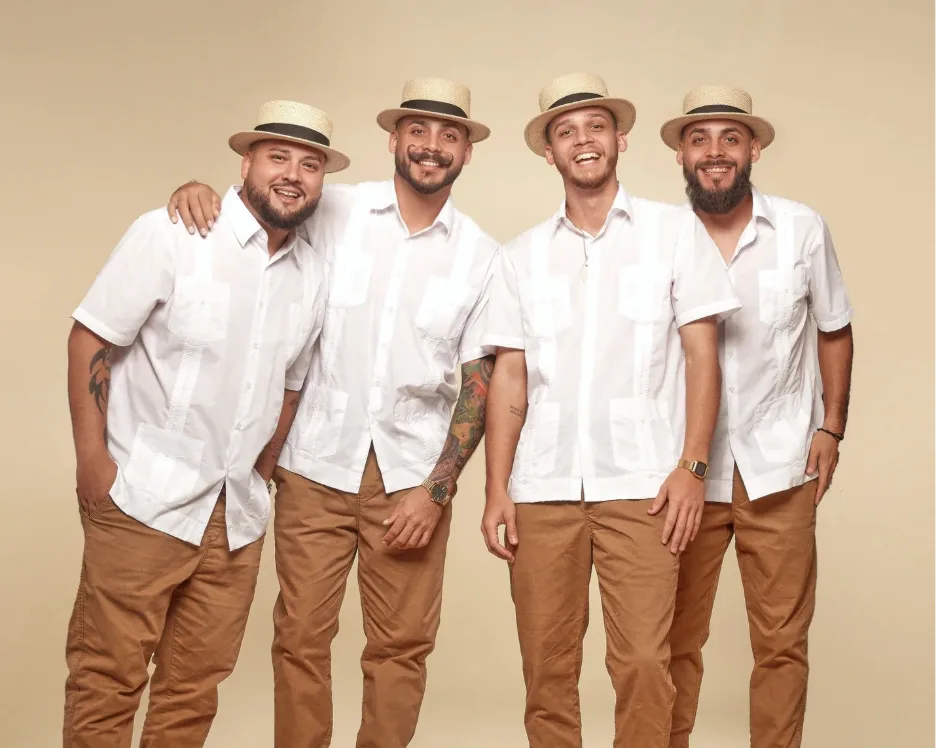
Los Pleneros de la Cresta, founded by four students at the University of Puerto Rico in 2013, have become one of the most important cultural forces in contemporary Puerto Rican music. In this conversation with Maristella Collazo-Soto, they share:
- How plena “chose” them** through childhood experiences at protests for Vieques
- The hardest year of their career: when refusing to work with certain promoters cost them performances
- The ten-minute encounter, that led to their collaboration with Bad Bunny on his latest album
- Performing at the National Stadium in Chile where Víctor Jara was murdered for singing protest songs
- The Super Bowl halftime performance, that brought plena to tens of millions
- Why legal and business structure matter as much as artistic vision for creative careers
A masterclass in building creative careers on integrity, purpose, and cultural pride.
What followed is a story that defies the easy narrative of “overnight success.” It’s a story of conviction, sacrifice, and the kind of integrity that costs you opportunities in the short term but earns you the world in the long run.
In this great episode of Así las Cosas, host Maristella Collazo-Soto sits down with the four members of Los Pleneros de la Cresta: Joshua, Josué, Joseph, and Jay, to explore how they became one of the most important cultural forces in contemporary Puerto Rican music, their unforgettable collaboration with Benito Martínez (Bad Bunny), and what it really takes to build a creative career on values rather than convenience.
Who are Los Pleneros de la Cresta?
Los Pleneros de la Cresta is an independent Puerto Rican music group founded in 2013 at the University of Puerto Rico’s Río Piedras campus. Composed of four members—Joshua, Josué, Joseph, and Jay—the group is dedicated to preserving and promoting Puerto Rican culture through plena, a traditional folk genre. The name “de la Cresta” references the rooster (gallito), the official mascot of the UPR Río Piedras campus. The group has released three studio albums, collaborated with Bad Bunny on his most recent album, performed at Super Bowl halftime, appeared on The Tonight Show with Jimmy Fallon, and completed a 31-night residency in Puerto Rico.
How Four Students Sparked a Cultural Renaissance
The story begins in 2013, in the hallways of the University of Puerto Rico at Río Piedras, an institution that has long served as a cradle of Puerto Rican identity, activism, and culture.
“We were students with hunger to keep defending our culture,” Joseph explains. “From the time we were little, we had the opportunity and the blessing to know, from the age of eight, what country music is: la montaña, los seises, los aguinaldos, la mazurca, la danza, la bomba, la plena. We were already in love with our folklore.”
The group’s distinctive name, Los Pleneros de la Cresta, comes from their alma mater. Joshua explains: “At the University of Puerto Rico, students are known as ‘gallitos’ or ‘gallitas’ (little roosters). The rooster is the mascot of the Río Piedras campus. And one of the rooster’s most characteristic features is its cresta (comb). So we drew inspiration from that, the gallito and the cresta.”
It’s a name that immediately marks them as Puerto Rican and as deeply connected to one of the island’s most iconic cultural institutions.
But what makes their story extraordinary isn’t just the name… it’s what they chose to do with it.
The First Drum: A Memory from Vieques
When Maristella asks why they chose plena over other genres, Joseph shares a memory that reveals the deeper roots of their commitment.
“One of the best experiences we had as children was being able to use Puerto Rican plena at a protest demanding that the Navy leave Vieques,” he recalls. “As a child, for the first time, a drum came into my hands. And being able to have that experience through plena helped us and taught us to strengthen our values, our vision, and our philosophy.”
That moment: a child holding a drum at a political demonstration for Puerto Rican sovereignty… plants the seed for everything that comes next.
For Los Pleneros de la Cresta, plena was never just music. It was therapy. It was protest. It was preservation. It was a way of saying, we are still here, and we still matter.
“The Plena Has the Responsibility of Affirming Our Values”
When they speaks about why plena matters, his words carry the weight of historical consciousness.
“Plena has, among other responsibilities, the responsibility of affirming our values as Puerto Ricans,” … “We obviously live in a colony, and for more than 600 years we have been in a constant attempt at denaturalization of what Puerto Rican identity is. It’s a constant attack on you feeling Puerto Rican.”
“Plena is the perfect vehicle for that,” Josué continues. “It’s the perfect vehicle to keep saying: yes, we are from Puerto Rico, and we are proud of who we are.”
How did Los Pleneros de la Cresta connect with Bad Bunny?
The story of how Los Pleneros de la Cresta connected with Benito Martínez (Bad Bunny) is the kind of story that only happens when you’ve been building something authentic for years.
The collaboration began at the Festival de la Esperanza, a political event in Puerto Rico closing the Victoria Ciudadana movement and Independence Party campaign. After being placed in the artist tent, Bad Bunny’s team entered minutes later. Within ten minutes, Bad Bunny approached the group personally, congratulated them on their work, and told them: “Keep making music.”
Another singer present then revealed that Los Pleneros de la Cresta would be featured on Bad Bunny’s next album, asking them to keep it confidential. The call to record came three to four days later. The collaboration would lead to performances at the Super Bowl halftime show and other historic moments.
The encounter lasted maybe ten minutes. Benito congratulated them on their work, told them to keep making music, and then said something that left them frozen:
‘I’m going to ask you please not to share this information with anyone. You’re going to be part of my next album.’: Bad Bunny
The Iceberg of Success
Maristella offers an image that captures their journey perfectly: the iceberg of success.
“People see the tip on top,” she says, “but they don’t see everything that happened underneath—how hard it is to get there, the glass you have to grind through to reach the top.”
For Los Pleneros de la Cresta, the underwater portion of that iceberg includes:
- Years of giving workshops in schools and communities for little or no money
- Refusing performances that conflicted with their values
- Structuring themselves legally and financially as a real business from the beginning
- Investing personal money to record their first tracks
- Building relationships with mentors at organizations like Guayacán Enterprises
- Showing up at small festivals for crowds of ten people before they ever saw 60,000
“Life starts to reward you when you are brave and authentic about who you are, what you believe, what you want to achieve. When something is meant for you, it’s meant for you.” Maristella Collazo-Soto
The Super Bowl, Jimmy Fallon, and a Stadium in Chile
When asked about their most memorable moments, the group can barely choose.
The 31-night residency in Puerto Rico. The Tonight Show with Jimmy Fallon. International stadiums where 60,000 people sing along to plena in countries thousands of miles from the Caribbean.
But one moment stands apart.
“The National Stadium in Chile,” Josué begins, “where they murdered Víctor Jara for singing left-wing songs. I believe it was during Pinochet’s victory.”
The group performed at that stadium—the very site where Jara was tortured and killed in 1973 for the crime of singing protest songs.
“José Eduardo played ‘Te recuerdo Amanda’ with Víctor Jara’s cuatro—the same songs they killed him for—in the place where they killed him. But with 100,000 people singing along.”
Joseph’s voice catches: “We cried there. To suddenly see ourselves in that place where this happened. That today we can enjoy it with joy and celebration because of those sacrifices. If we had lived in that era, we would have been the ones destroyed there. Without hands. To think about those things…”
“And knowing that, recognizing that, is what leads us to also recognize how important it is for us to be the bridge.”
The Legal Foundation: Protecting What You Build
One of the most striking aspects of Los Pleneros de la Cresta’s story, particularly for a legal audience, is how seriously they’ve taken the business side of their art.
“We had the blessing to be part of Guayacán Enterprises,” Joseph explains. “That was also an opportunity to see this as any business. And formalize it as any business. If you’re going to set up a restaurant or a clothing store, you have to structure yourself the same way. You need seed capital. Our seed capital was recording a song.”
This is a powerful message for emerging artists everywhere: creative careers require the same business discipline as any other venture.
That’s why they advocate for proper legal protection, accounting structures, and royalty management—not just for themselves, but as a model for the next generation of plena artists.
Why is legal and business structure important for independent musicians?
Independent musicians must structure themselves as proper businesses to protect their intellectual property, manage royalties, and build sustainable careers. Los Pleneros de la Cresta emphasize that creative careers require the same legal and financial discipline as any other business: “If you’re going to set up a restaurant or a clothing store, you have to structure yourself the same way.” Key elements include: proper legal entity formation, accounting structures, copyright protection, royalty management, and accessing mentorship through organizations like Guayacán Enterprises in Puerto Rico.
As Maristella Collazo-Soto notes, “It happened to Taylor Swift. If you don’t properly manage ownership of what you produce, compose, and create, you can have all the access in the world, but you’re not going to receive the economic rewards.”
A Call to Their Colleagues
When asked about what they want from their fellow artists, Joshua offers a direct call to action:
“This is directed to my colleague artists. Please give yourselves the opportunity to sing plena, also bomba, music of the countryside. And if you’re going to do it, also do your research. There are many groups doing very good work, not just us. Open the doors to the world if you’re at that level.”
But he goes further. There’s a right way to do it.
“If we’re going to sing plena, if we’re going to record plena, dance it, let’s also do the exercise of having panderos. Within that recording, let’s have choruses, have someone else sing besides that featured artist. Let collaboration be more than just the rhythm. Don’t just walk into a studio, have some congas, record a plena base, and say: ‘Ah, I made a plena, I’m singing plena.’ Go a little further. Go to the groups that are doing this work and are ready to have an opportunity like the one we had.”
It’s the kind of generosity that only comes from people who remember what it felt like to be unknown—and who refuse to forget.
What This Conversation Teaches Us
Los Pleneros de la Cresta’s story offers lessons that extend far beyond music:
On purpose: “Purpose moves everything—above anything else.” When you know why you’re doing something, the how becomes possible. The what becomes inevitable.
On integrity: “Positions cost.” Saying no to wrong opportunities is what makes you available for the right ones. The year you stop accepting compromises is the year your real career begins.
On business discipline: Creative careers require the same legal, financial, and structural rigor as any other business. Protect your work, structure your business, and invest in proper representation.
On opening doors for others: Success that doesn’t lift others is incomplete. The artists who reach the mountain top owe something to those still climbing.
On cultural pride: “Plena is the perfect vehicle to keep saying: yes, we are from Puerto Rico, and we are proud of who we are.” Identity is not nostalgia. It’s a foundation for the future.
On collective thinking: “I am Puerto Rican, therefore I exist.” When you make decisions from a place of belonging—to a culture, to a community, to a tradition—you make better decisions for everyone.
Watch the Full Episode
The complete conversation between Maristella Collazo-Soto and Los Pleneros de la Cresta explores:
- The origin story at the University of Puerto Rico
- How plena became their chosen vehicle for cultural defense
- The Vieques protest where Joseph first held a drum
- The ten-minute encounter that led to working with Bad Bunny
- The hardest year of their career and what they learned
- Performing at the National Stadium in Chile where Víctor Jara was murdered
- The Super Bowl moment and what it meant for Puerto Rican culture
- Why proper legal and business structure matters for artists
- A call to colleagues to open doors for other plena artists
- Their dream legacy: a Puerto Rico that thinks collectively
Watch the full episode now and subscribe to Así las Cosas by Ferraiuoli to never miss conversations with Puerto Rico’s most extraordinary cultural voices.
Disclaimer: Ferraiuoli LLC does not necessarily endorse the expressions or opinions shared in this episode.