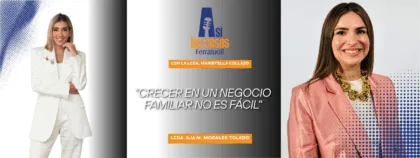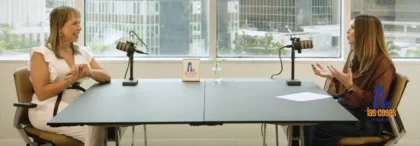
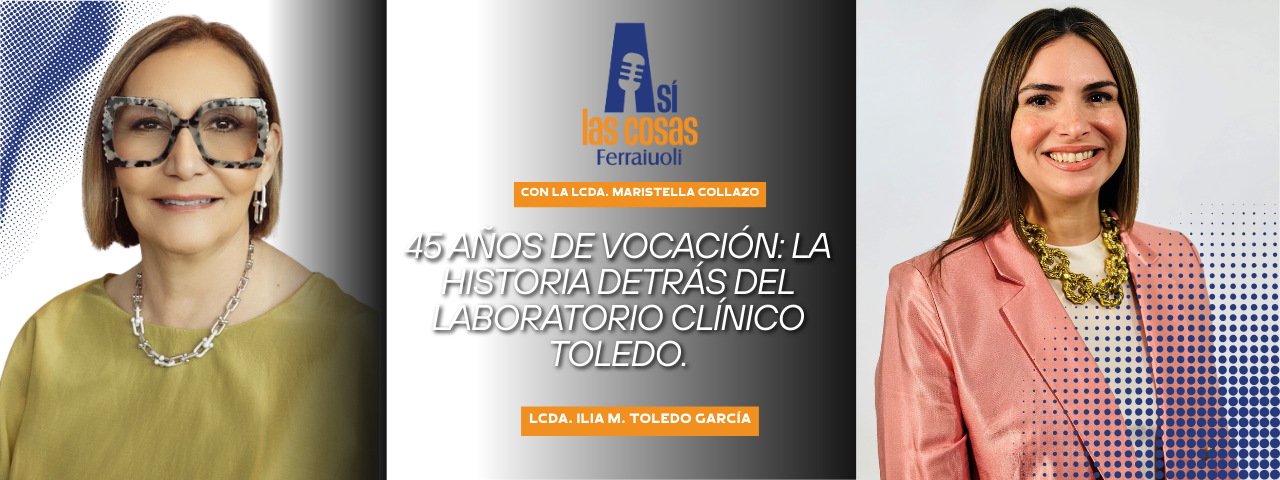
In the latest episode of Así Las Cosas, Ferraiuoli’s podcast hosted by Maristella Collazo-Soto, Capital Member and Co-Chair of the Intellectual Property Practice Group, we sit down with Ilia Toledo, a Puerto Rican business leader whose story reflects what happens when professional excellence, strategic risk-taking, and service to community move in the same direction. From long hospital shifts to founding and scaling one of the island’s most recognized clinical laboratory operations, Toledo’s journey is ultimately about one principle: staying ready for what Puerto Rico demands, even when the odds shift overnight.
This conversation is a portrait of entrepreneurship, also a real-world case study in operations, decision-making under pressure, and building trust in an industry where quality is measured in outcomes, not slogans.
From Arecibo to the Bench: The Early Years That Shaped a Leader
Toledo was born and raised in Arecibo and pursued medical technology studies at Mayagüez before launching her career inside hospitals, the kind of environments where “extended shifts” and constant responsibility are the baseline, not the exception.
Those years mattered. In clinical environments, discipline is operational, not aspirational: accuracy, process, and consistency aren’t “values”, they are survival. It is the type of foundation that later makes entrepreneurship in healthcare less about chasing growth and more about building systems that don’t break.
In 1984, Ilia Toledo helped open her first laboratory in the town of Florida.
But the milestone came in 1988, when she opened Laboratorio Clínico Toledo, in Arecibo, and made an operational choice that changed the trajectory: extended hours.
That decision sounds simple until you consider what it signals: a lab designed around the lives of working families, parents, and patients who cannot always fit healthcare into a standard “8-to-5” window. Operational empathy became a business differentiator, and it stayed embedded in the model.
The Hidden Infrastructure, What Most People Never See
One of the most valuable angles in this episode is how it pulls back the curtain on what clinical lab service truly entails.
It is not only “drawing blood.” It is logistics, chain-of-custody, temperature controls, automation, barcoding, routing, and error prevention. All engineered so that a patient and physician can trust that a result is reliable.
That point is important for a broader audience: healthcare systems don’t run on headlines. They run on operational excellence.
Scaling with Structure: Family Support and Corporate Evolution
Behind the founder story is also a family system that made the pace sustainable. Toledo describes the support of her husband during years of intense work, a reminder that business growth is rarely an individual achievement; it is often built on invisible shared responsibility.
As the organization grew, Toledo incorporated her daughter, Ilia Margarita Morales Toledo, into the business, a turning point that enabled deeper professionalization: new departments, clearer structures, and a more corporate operating model.
In other words, growth required a new internal architecture and the willingness to evolve beyond the founder’s original “do-everything” mode.
Why Puerto Rico Matters: A Local Reference Lab That Keeps Quality on the Island
She highlights how physicians often default to national labs in the mainland U.S., and how difficult it was (especially early on) to shift those habits.
But her argument is operational and clinical, not emotional: when samples travel, variables increase. Laboratorio Toledo positioned itself as a local reference laboratory capable of performing specialized testing at scale, and today, the lab reports that it performs 98% of tests in-house, sending only a small portion elsewhere.
For Puerto Rico, it is a resilience story: local capacity reduces dependency, speeds up care pathways, and keeps critical healthcare infrastructure closer to the communities it serves.
Crisis Leadership. Hurricane María and COVID-19
Puerto Rico is a market where continuity planning is not optional. It is reality.
Toledo describes how, after Hurricane María, logistical breakdowns meant that off-island sample processing became harder, but her operation was able to remain in motion, serving as a solution when alternatives failed.
That pattern repeated, at an even higher intensity, during COVID-19. Toledo recounts early preparation while the virus was still making headlines abroad, followed by developing an in-house test when commercial options were limited, and pursuing an Emergency Use Authorization (EUA) process so testing could scale locally.
This is what preparedness looks like in practice: not reacting to crisis, but designing the organization to function through it.
Today’s Reality: Energy, Cybersecurity, and the Cost of Staying Operational
The interview also goes where business conversations often avoid: the unglamorous risks.
Toledo points to a persistent constraint in Puerto Rico’s infrastructure — electricity reliability — and the financial and operational consequences for sensitive laboratory equipment.
She also shares a blunt modern threat: a cyberattack that temporarily paralyzed systems — and the urgency required to restore operations quickly, because clinical labs carry responsibility not only to clients but ultimately to patients who cannot wait.
The takeaway is clear: in healthcare, “business continuity” is not a corporate buzzword. It is a form of care.
Leadership Beyond the Lab: Service as a Business Principle
Toledo’s leadership extends into civic work as well. She currently serves as President of the Board of SER de Puerto Rico — an organization connected to therapies and community impact that support many families across the island.
That piece matters because it completes the portrait: entrepreneurship as service, not only as scale.
Hear Ilia Toledo’s full story — including the operational decisions, personal realities, and the commitments that shaped Laboratorio Clínico Toledo — in the latest episode of Así Las Cosas by Ferraiuoli (Spanish), in the YouTube channel.